
Self-Study Program



6
Production
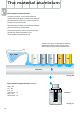
The raw material for aluminium is bauxite.
– Forms as a result of the weathering of
limestone and silicate rocks under
appropriate climatic conditions.
– Named after the location in which it was
discovered - Les Baux (southern France)
The material aluminium
Today Bauxite is the second most frequently
used metal after steel, even though it has only
been possible to produce it economically for
approximately a century.
The difficulty lies in the fact that it is very
difficult to extract from the ore, as aluminium
reacts with oxygen to form a very stable
oxide, which means that it cannot be
recovered (smelted) from the ore using
carbon, as in the case of iron or copper.
It was not until Werner v. Siemens produced
his dynamo at the end of the 19th century
that it became possible to produce
aluminium on an industrial scale by
electrolytic methods.
USA previously
USSR
Germany Norway
SSP239_069
3,4
2,5
0,75
0,75
Bauxite
3%
7% 28% 62%
NaOH
Electrolysis
Primary aluminium pig
Titanium oxide
Silicon oxide
Iron oxide
Aluminium oxide
Aluminium smelting
Production [in millions of tons, 1980] in
certain countries of production