239 239 Service. AUDI A2 - Body Construction and Function Self-study programme 239 All rights reserved, including the right to make technical changes. AUDI AG Dept. I/VK-5 D-85045 Ingolstadt Fax 0841/89-36367 040.2810.58.20 Technical status 02/00 Printed in Germany For internal use only.
The Audi-Space-Frame ASF® in the A2 Audi A2 development targets Measures Weight savings of at least 40 % with respect to a comparable steel body as a precondition for a future 3-litre vehicle. This is achieved with an aluminium SpaceFrame body design. Using the full potential of lightweight construction This is made possible with the use of further developed semi-finished aluminium products: cast aluminium, extruded profiles and rolled sheet metal.
Contents Page The material aluminium Historical development at Audi . . . . . . . . . . . . . . . . . . . . . . . . . . . . . . . . . . . . . . . . Manufacturing . . . . . . . . . . . . . . . . . . . . . . . . . . . . . . . . . . . . . . . . . . . . . . . . . . . . . . Properties . . . . . . . . . . . . . . . . . . . . . . . . . . . . . . . . . . . . . . . . . . . . . . . . . . . . . . . . . . Recycling . . . . . . . . . . . . . . . . . . . . . . . . . . . . . . . . . . . . . . . . . . . . . . . . . . . . .
The material aluminium Historical development at Audi Vehicle concepts Audi Space Frame A2 Audi A2 1999 1994 Audi Space Frame A8 Audi A8 1991 1984 Avus quattro study Early stage of the Space-Frame technology Audi 100 - aluminium sheet metal vehicle 1913 4 Aluminium vehicle NSU 8/24 Long-distance saloon completely made of aluminium SSP239_008
Use of light metal alloys 1999 Audi Space Frame in the Audi A2 A6 bonnet, wings and back panel made of aluminium in the A6 V8 1998 TT bonnet crankcase for the 1.8 l in the A6 Crankcase for the 1.6 l in the A3/A4 Avant Door subframe Audi A6 A6 bonnet 1997 Light alloy wheels as standard on the A4/A6/Cabrio Light alloy wheels as standard on the A3 Aluminium oil pan for the V6 petrol and TDI Transverse link Audi A8 Audi Space Frame ASF in the A8 1994 1991 Crankcase 4.
The material aluminium Production The raw material for aluminium is bauxite. – Forms as a result of the weathering of limestone and silicate rocks under appropriate climatic conditions. – Named after the location in which it was discovered - Les Baux (southern France) NaOH Bauxite 28% 62% Aluminium oxide Iron oxide 7% Silicon oxide It was not until Werner v.
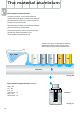
Aluminium - production and recycling Under high energy expenditure, Bauxite is processed into aluminium oxide and then via electrolysis into primary aluminium pig. By the addition of magnesium and silicon (the key alloy components) it is then transformed into high quality aluminium alloys. Bauxite These alloys form the foundation for extruded profiles, cast joints and rolled sheet metal aluminium.
The material aluminium Properties Advantages of aluminium – Aluminium has only about 1/3 of the specific weight of steel. – Good mechanical strength properties Strength ranging from 60 to over 500 N/mm2 – It reacts with the oxygen in the air form a thin layer of oxide, which constantly regenerates and protects against further destruction of the material. – Good resistance to atmospheric and saltwater corrosion – Good plasticity properties – Aluminium alloys are easy to reuse and recycle.
Rigidity of an ASF® body The higher rigidity of an aluminium body compared to a steel body is due exclusively to the larger cross-sections and corresponding sectional designs. Every component of the raw body shell has been dimensioned perfectly in terms of its cross-section and weight to meet the strain that will be placed on the material. This forms the basis for a statically and dynamically rigid aluminium body.
The material aluminium Electrochemical potential series Contact corrosion occurs when different metals that lie far apart in the electrochemical potential series come into contact under the presence of an electrolyte. The metal that is lower in the electrochemical potential series is electrolysed. The electrolysation is more pronounced the further the metals are apart in the electrochemical potential series.
Threaded connections on the Audi A2. All fastening components that come into contact with aluminium are coated with Dacromet, Delta Tone or a similar coating to prevent contact corrosion. In addition these parts are coloured with a green lubricant on an alkyd resin basis to provide a clear distinction to normal fastening components. Surface protection SSP239_005 Available coatings for prevention of contact corrosion 1. coatings containing zinc and aluminium dust (Delta Tone®, Dacromet®) 2.
The material aluminium Recycling The high scrap value of aluminium makes collection and recycling economically viable. The energy expenditure involved is low. The quality and the properties of the material are retained. The economic advantages of thorough sorting are made clear by the trade values of scrap metals. Suitable methods for fully-automated sorting of metals according to alloy constituents are available (laser detection).
Energy expenditure Production Operation of the vehicle Additional energy expenditure Basis Conventional steel body Energy savings SSP239_004 In terms of aluminium recycling the Audi Space Frame ASF® is better from the start. Energy savings The use of primary aluminium entails an initially high expenditure of energy, but this is offset after a certain driven distance by savings of other energy carriers, e.g. fuel.
Audi Space Frame – ASF® Technological concept Comfort Performance Safety Universality Body rigidity Vehicle layout adaptation Tank capacity Engine adaptation Running gear adaptation Leightweight body New overall technological concept Lightweight materials Engine Gearbox Running gear Vehicle layout Tank capacity Weight Current level Target weight 450 Body weight [kg] 400 D-class 38 % weight reduction Steel 350 300 Ao-class A8 250 200 Aluminium 43 % weight reduction A2 150 100 3,00 SSP239
Innovations of the Audi Space Frame in the A2 SSP239_096 Manufacturers face conflicting requirements during the development of a new vehicle or redevelopment of an existing one. On the one hand, the vehicle should have a high degree of variability with the best possible equipment and the lowest possible fuel consumption. On the other hand, the additional equipment and various adaptation measures cause an increase in weight, which counteracts low fuel consumption.
Audi Space Frame – ASF® Overview of ASF® - A8 and A2 SSP239_012 Frame® Rolled sheet metal Extruded profiles Cast metal The Audi Space A8 is a compound of aluminium profiles and die-cast aluminium joints. All of the other aluminium body parts are attached to this Audi frame construction by MIG welding, punch rivets, adhesive bonding and clinching. Weight distribution Rolled sheet metal parts - 55 % =138.20 kg Extruded profile parts - 22.7 % = 56.50 kg Cast parts - 21.8 % = 54.
Rolled sheet metal Extruded profiles Cast metal SSP239_013 The Audi Space Frame® A2 consists of a compound of aluminium extruded profiles in multi-functional vacuum die-cast parts (large cast parts). Through continuous further development it has been possible to reduce the number of parts. The laser welding process is new. Weight distribution Rolled sheet metal parts - 60.6 %= 92.80 kg Extruded profile parts - 17.6 % = 27.00 kg Cast parts - 22.1 % = 33.20 kg ––––––––– Overall weight of the ASF® =153.
Audi-Space-Frame – ASF® Components Multi-functional large cast parts with function-optimised wall thickness and weight, plus optimised component structure. Bolted longitudinal member As well as having very good strength properties, vacuum die-cast parts also display very good deformation characteristics, and they are predominantly used in crash-relevant areas of the structure, for example in the longitudinal members 2, the suspension strut holders and A- and B-pillars.
Improvements to the vacuum die-cast process now mean that much larger components can be produced, such as the Aand B-pillars in the Audi A2. Cast parts in the ASF® A8 Joint elements with tolerance compensation These parts are manufactured using the vacuum die-cast process (Vacural®). Pore arms and easily weldable parts are a requirement for the subsequent assembly process. These parts display good properties in terms of their crash response with regard to deformation and energy absorption.
Audi-Space-Frame – ASF® Attachment of the centre floor pan and the rear end The frame of the underbody structure consists of straight extruded profiles joined together by MIG fillet welds. As a result, the cast joints that were still necessary in the Audi A8 are no longer required. The rear end also has a relatively simple structure, consisting of longitudinal members and cross pieces, and is attached to the centre floor pan by another multi-functional large cast part.
Ancillary and outer shell panels The materials used on the Audi A2 are mainly heat-hardened. This is because they offer the best compromise between good plasticity, good mechanical properties and good anticorrosion properties. After the material has been formed or the raw body shell has been completed, the properties of the material are changed by heat treatment (205 oC) in the body assembly line.
Audi Space Frame – ASF® Reduction of the number of body parts Side panel SSP239_014 The side panel on the A8 consists of 8 parts. SSP239_015 The side panel on the A2 is a single part.
Comparison of the B-pillar between the A8 and the A2 Extruded profile 1220 1150 Chill casting Rolled sheet metal SSP239_016 SSP239_017 The B-pillar on the A8 consists of 8 parts and requires various production methods. The B-pillar on the A2 is made in one part, requiring only one production method.
Bonding techniques Overview Comparison of profile types A comparison of the different profile types highlights the great importance of shaping on the effectiveness of vehicle body shell production, and therefore directly on the number of vehicles produced per day. The reduction of complex final trimming improves the relative dimensional accuracy of the parts, as a result of which the necessary tolerance compensations can be reduced to a minimum.
Production method Punch-riveting SSP239_066 The number of punch rivets has increased by around 40 % to approx. 1800 compared to the A8. This is because the bonding techniques “beading” and “resistance spot welding” are no longer used. This is a result of the positive experiences that were made with punch riveting on the A8-Space-Frame. Only semi-tubular rivets are used in the A2Space-Frame, with different dimensions depending on the component combination.
Bonding techniques Internal high pressure metal forming IHF SSP239_020 Sheet metal parts Cast parts IHF extruded sections non-IHF Process sequence: IHF and bending IHF formed roof frame on the A2 The high degree of design freedom in terms of the cross-sectional geometry of extruded profiles makes it possible to optimise components in terms of shape, function and weight. The required tolerances of +/– 0.2 mm can only be achieved by IHF. Subsequent processing stages are not required.
Production sequence, shown on the example of a longitudinal member Once it has been cut to length, the profile is laid into a tool consisting of an upper part and a lower part. SSP239_024 As the tool closes the flange is trimmed. At the same time, the axial cylinders are driven in and the profile is filled with liquid. Hole cylinder A pressure of approx. 1700 bar is then built up, and the profile is formed in the tool shape and calibrated.
Bonding techniques Metal inert gas welding MIG welding is used to join together extruded profiles to build up the frame structure. With this thermal bonding technique extensive production experience is available. On the Audi A8 approx. 70 m of welds on each vehicle are MIG-welded. This method has established itself as economical and highly flexible. However, its disadvantages are the high heat impact and the low bonding speed. The Audi A2 only requires about 20 m of MIG welds.
Laser welding SSP239_051 The process of laser welding is used to weld sheet metal/extruded profiles and cast parts.
Bonding techniques Use of lasers on steel Audi vehicles A4 saloon C-pillar Use of lasers in production of raw body shells A6 saloon/Avant Roof/side A4 Avant Roof/side 30 A3 Roof/side TT C-pillar (brazing)
Laser weld seams in the ASF® of the Audi A2 SSP239_073 Laser weld seams At the time of production planning for the A8 it was felt that laser welding of aluminium alloys was not yet fully achievable, which is one of the reasons why MIG welding was chosen. However, serious consideration was given to alternative welding methods already in the concept phase of the A2-Space-Frame.
Bonding techniques Laser weld joins on the B-pillar Laser welding is predominantly used on the A2 for the welding of large area sheet metal parts with the body structure of cast metal and extruded profiles.
Laser weld joins in the floor assembly Floor pan Cross piece Extruded profile Laser weld joins Connecting piece Vacuum die-casting SSP239_061 There are a total of approx. 30 m of laser weld seams on the A2-Space-Frame. Examples for this are the attachment of the B-pillar, the joining of the floor panels to the MIG-welded extruded profile frame structure, the attachment of the roof to the body superstructure or the joining of the one-part side panel to the roof frame and the doors.
Open Sky Design and function SSP239_036 Roof closed The Open Sky glass module roof is the first roof system in the world to fill out the entire roof of the vehicle. The continuous glass forms a complete unit. The roof system reaches from the windscreen to the rear window, and from the left-hand side panel fame to the right-hand frame. 34 The transparent area as seen from inside the vehicle is approx. 166 % larger than on a comparable opening roof.
Roof open SSP239_037 When the roof is open additional fresh air is provided on top of the vehicle’s fresh air system. This provides very pleasant ventilation.
Open Sky SSP239_038 Front part of roof opened If the front part of the roof is opened then the front part of the glass roof moves back over the rear part. At the same time a wind deflector is raised. It reduces the wind noise that otherwise arises from the air flow and also prevents draughts.
SSP239_039 Roof fully opened at front and rear If the glass module is fully opened then the front part of the glass roof moves back over the rear part, picking it up and taking it to the rest position. A freely moveable screen reduces the amount of sunshine entering the vehicle without any loss of ventilation. A water run-off system integrated into the roof frame prevents the ingress of residual water while the roof is being opened, as well as the ingress of rain water or wash water.
Open Sky Assembly work The glass module roof is assembled from above on the tubular structure of the vehicle, and then bolted to it from below. The height adjustment of the module is preset by special tool VAS 6010 and ensured by height adjustment elements. The module frame consists of two guide rails, a fixed glass roof at front and rear and a tube carrier which is to contain the operating cables for the electrical drive. A foam seal provides the necessary sealing.
Occupant protection SSP239_093 The Audi A2 is equipped with full-size airbags as standard on the driver’s side and the passenger side. The layout of the airbag systems, including the size of the bag, the characteristics of the gas generator and the exiting speed of the gas after ignition, was optimised and coordinated with the aid of virtual development and simulation tools.
Occupant protection Simulation is a very important tool for the development of occupant protection systems. At an early stage it is possible to determine the main deforming processes from the structural behaviour based on CAE calculations. Simulation offers the possibility to view and optimise the structural behaviour and the effectiveness of the occupant protection system as a whole unit.
SSP239_089 The aluminium bumper consists of a multichamber hollow profile and forms a weight and force-optimised crash unit together with the longitudinal member system and the structure of the occupants’ cell. Planned deformation of the front end dissipates the impact energy without affecting the stability of the occupants’ cell.
Occupant protection Airbag control unit J234 A self-test is performed every time the ignition is switched on. The system checks to see whether the connected peripherals actually match the coded equipment version. The deceleration curve caused in a collision is detected by the control unit, which then decides which of the different airbag systems to trigger. If the deceleration is below the reference values set in the control unit then the airbags are not triggered.
Ball seatbelt pre-tensioner Both of the front seatbelt inertia reels are equipped with pyrotechnic tensioners that are triggered with an appropriate force in the event of an accident. The balls are driven by a pyrotechnical propellant load. This kinetic energy is transferred via a gear wheel to the belt capsule. The seatbelt is wound up to remove any belt slack and reduce the load on the occupant.
Occupant protection SSP239_021 The head airbag module is located on the left and right, above the doors behind the headlining. It stretches from the D-pillar (attachment of the ignition module) to the A-pillar. It unfolds as a single bag along the side windows. Depending on the situation in which the airbag is triggered the head airbags may trigger together with the side airbags on the side of the impact.
Airbag key switch (optional) The airbag key switch in the glove box enables the driver to deactivate the passenger airbag (optional). Deactivation via tester VAS 5051 takes priority over deactivation with the airbag key switch. SSP239_044 Passenger airbag OFF warning lamp A warning lamp is permanently lit up to inform the driver that the passenger airbag is switched off.
Repair concept The experiences with the repair concept of the A8 were taken as the starting point for a new repair concept to take in the special features of the A2. As a result the repair times are reduced and the repair costs are less than or approximately the same as standard steel bodies, despite the new body technology.
one part in service lid bolted welded one part in service lid push-fit and quickrelease 3-part in service adhesive bonding and riveting bolted Rolled sheet metal Extruded profile Cast metal Inner/outer wheel housing adhesive bonding and riveting in service bolted SSP239_013 Depending on the different types of semifinished products (sheet metal, cast parts and extruded profile parts), different concepts are used for repairs on the A2. Any existing punch rivets, e.g.
Repair concept Different strength grades in the areas of the body most prone to impact in an accident are designed to keep the depth of damage and therefore the associated repair costs as low as possible. The layout of the front end is designed accordingly. A repair concept that has already been applied on the Audi A8 is the replacement of bolted components (see page 58). For example, the front longitudinal member is the weakest component in the front end structure.
As a general rule, damaged cast parts must always be replaced. For strength reasons reshaping is not permitted. Due to the high rigidity there is a risk that cracks will form. The bonding techniques that are used are MIG welding, riveting and adhesive bonding. The general repair process is demonstrated on the B-pillar. SSP239_098 Extruded profile parts must be replaced if they are damaged. Any reshaping would be uncontrollable.
Repair concept SSP239_100 The assessment of damaged components must pay particular attention to checking both the weld seams and the cast parts for cracks. A dye penetration test is used to check for surface cracks.
Notes 51
Painting After the raw body shell has been finished and the heat treatment has been carried out, the body is cleaned and prepared with a 3-cation phosphating layer (Zn = zinc, Ni = nickel, Mg = manganese) that forms a bonding layer for the subsequent cataphoretic immersion painting (CIP). By modifying the phosphating (addition of fluorides) it is possible to pre-treat fully galvanised steel and aluminium bodies together.
Cataphoretic immersion paint primary coating (CIP primary coating) After the phosphating process the body receives a cataphoretic primary coating, which provides an excellent protection against oxidisation. Cataphoresis (movement of positively charged particles through a liquid) is an electrical process which is also known as electrophoresis (transport of electrically charged particles through an electrical current). The body is fully immersed in a tank containing a paint-electrolyte solution.
Review ASF® in the Audi A8 Longitudinal member II Advantages of the aluminium cast metal parts This cast joint joins the longitudinal members I and II with the bulkhead, floor assembly and the wheel housing shell.
Front suspension strut holder This part has a highly complex geometry, with many connections and a very high degree of rigidity. It forms the join between the longitudinal member, the bulkhead and the plenum chamber. SSP239_076 (SSP160_019) Door sill profile A closed profile with wall thicknesses varied all around enables the largest possible crosssection for the available space and the best use of materials. The integrated bridge acts as a wiring duct.
Review The lower A-pillar Due to the high safety requirements the A-pillar is a multi-chamber profile. In the lower area it connects the wheel housing, longitudinal member arm, door sill and floor assembly. Most of the joins are MIG welded to produce an extremely rigid unit. This construction method also uses less individual parts. A comparable body design could not be achieved with steel (weight).
Adhesive bonding Adhesive bonding techniques are used on the doors and lids of the A8. An epoxy adhesive is used, as is typical for doors and lids in steel constructions. The modified epoxy adhesive is used on joining flanges in the area of the door cut-out, floor and suspension strut support.
Review Repair concept The damaged longitudinal member is separated The crashed longitudinal member displays optimum folding characteristics and is quick and easy to replace thanks to the bolted connections. Damaged longitudinal member SSP239_082 (SSP160_043) Bolted solution for longitudinal member The front longitudinal member consists of three parts. Deformation element (tube), stable extruded profile with suspension strut holder and the bolted connection of the longitudinal member as a cast joint.
Door sill replacement The defective door sill extruded profile is renewed as a section (as far as it is damaged). The cast joints are not damaged, which enables economical repairs. The deformed extruded section is cut out, and the replacement part is welded in using socket welds. Deformed sill SSP239_083 (SSP160_046) Door sill replacement During a side impact the “cast joint and extruded section” construction responds in an exemplary manner.
Review Anchoring set (4x) The anchorages can be adjusted in all three dimensions to enable quick and easy securing of the vehicle.
Body repairs should currently only be performed on a Celette repair bench. Attachment set (for bench-type straightening system) The connection points are only shown on one side for ease of illustration. The straightening set system MULTI-Z These parts allow the seating of all vehiclespecific terminal sets. No special tools are required. MULTI-Z is the latest tool available for diagnostics and repair technology.
Review Rubber and plastic parts With rubber and plastic parts (particularly EPDM and chloroprene) and with adhesives the electrical conductivity and therefore the risk of contact corrosion is caused by the presence of carbon black filler. In addition to the material description, all of the affected parts in the drawing contain the following note in the text field in the material column: “Electrical insulating properties”.
Notes 63
239 239 Service. AUDI A2 - Body Construction and Function Self-study programme 239 All rights reserved, including the right to make technical changes. AUDI AG Dept. I/VK-5 D-85045 Ingolstadt Fax 0841/89-36367 040.2810.58.20 Technical status 02/00 Printed in Germany For internal use only.