
Operating instructions


004 859 Page 5
SECTION 2 − PARALLELING
NOTICE − These procedures should only be used to parallel welding power sources manufactured by Miller Electric Mfg.
. The welding power source Owner’s Manual may provide additional information on how to connect units in parallel.
2-1. Typical Uses For Paralleled Welding Power Sources
When amperage demands for a particular application exceed the capabilities of one welding power source, two or more electrically similar welding
power sources may be connected in parallel to provide the amperage required.
When paralleled correctly, the amperage of the paralleled welding power sources is the sum of the amperage supplied by each power source. Voltage
remains the same as for one welding power source.
Compatible inverter DC welding power sources or engine driven welder/generators, or transformer-type welding power sources can be paralleled.
Each type requires special attention to certain areas unique to the equipment involved. The safety and efficiency of a paralleled system depends upon
careful attention to correct paralleling procedures.
. It may be advantageous to use a single welding power source capable of providing the required amperage rather than connecting units in parallel.
. The weld output of two power sources connected in parallel may be less than the total weld output of the individual power sources. Contact Miller
Electric Mfg. if you do not understand these procedures.
2-2. Equipment
The following equipment can be successfully paralleled:
D DC Constant Current (CC) Rectifier-Type Power Sources
D DC Constant Current (CC) Inverter-Type Power Sources
D DC Constant Current (CC) Rectifier Engine-Driven Welder/Generators
D AC Constant Current (CC) Transformer-Type Power Sources
The following equipment is not recommended for paralleling:
D Most DC Constant Voltage (CV) Power Sources
D Brush Commutator Design Engine Driven Welder/Generators
D Motor Generator DC Power Sources
D AC Engine Driven Welder/Generators
D AC Inverter-Type Power Sources
SECTION 3 − RECOMMENDED EQUIPMENT
3-1. Paralleling DC Constant Current Power Sources
Two or more DC transformer/rectifier or inverter power sources can be paralleled as follows:
1. Each power source to be paralleled must be individually protected (fused). For transformer/rectifier units, all must be connected to the same pri-
mary input power feed and be connected the same phase to phase.
2. Power sources must all be connected for the same polarity. If the power sources are equipped with polarity switches, they must all be set for the
same polarity.
3. Make sure each power source to be paralleled is in constant current (CC) mode.
4. If the power source has various output terminals such as High and Low (range), use the same range terminal on all power sources connected in
parallel.
If the power sources are equipped with a range switch, the range switch on all paralleled power sources should be in the same range.
5. Amperage adjustment controls on all power sources should be adjusted to provide the same output. Do not split the load unevenly. For example, if
800 amps are required from a paralleled connection of two power sources, adjust amperage control of each power source to provide 400 amps.
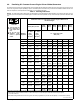
6. The amperage being used and total length of cable must be considered when selecting cable sizes. Use Table 3-1 to select weld cable size. Use
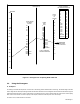
Figure 1-1 to compute weld cable size.