
Operating instructions


004 859 Page 8
B. Example 2
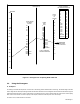
The welding current will be 400 amperes DC. The total lead length is 400 feet. The weld cable available is 4/0.
Draw a straight line from 400 amperes through 400 feet and intersect the reference line. Draw a straight line from the reference intersection through 4/0
cable. The result is a 7.8 volt loss which is above the 4 volt loss recommended.
The solution: Use two 4/0 cables in parallel for the work lead and electrode lead. The 7.8 volt loss can be halved by doubling up the cables. This gives a
3.9 volt loss because each cable is carrying 200 amperes.
C. Example 3
A construction company uses electrode holders with a 30 foot whip of 2/0 cable as standard equipment. The largest electrode used requires 400 am-
peres DC maximum. For standardization, all leads are cut to 50 foot lengths. What size cable should be used for these 50 foot lengths to keep voltage
loss below the recommend 4 volts.
Draw a straight line from 400 amperes through 30 feet and intersect the reference line. Draw a line from the reference intersection through 2/0 cable.
The result is a 1 volt loss. The 30 foot whip of 2/0 cable is sufficient to handle 400 amperes.
Draw a straight line from 400 amperes through 100 feet (50 foot work lead and 50 foot electrode lead) and intersect the reference line. Draw a straight
line from the reference intersection through 3/0 cable (the smallest cable size capable of handling 400 ±100 amperes). The result is a 3 volt loss.
The solution: The 50 foot leads should be 3/0 cable to handle 400 amperes with a 3 volt loss. If the work is further than 50 feet from the machine,
recalculate. It may be necessary to use several paralleled cables to handle the output.
Notes