
Developers guide




27
3.4 Java Automation System (JAS)
3.4.1 Introduction
The Java Automation System (JAS), developed by Keith Bannister in [ 52 ], was designed to
provide multi-user, secure, distributed automation of the APT system.
In early 2002, the JAS was redesigned to improve its functionality and to further abstract its
dependence on the JSDT package. The Java Shared Data Toolkit (JSDT), discussed in detail in [
52 ], is essentially the middleware which facilitates network communication of the JAS.
Unfortunately Sun
i
has ceased development and support of the JSDT in favour of JXTA. JXTA, or
Project Juxtapose, is Sun’s peer to peer solution for distributed computing. In light of this, it is
desirable to implement an alternative JAS transport layer, based on JXTA, as discussed in
Chapter 7.3.7.
The primary function of the JAS is to allow the remote execution of Commands and the
distribution of data to multiple clients, whilst restricting control to authorised users.
3.4.2 Architecture
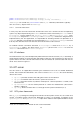
The basic operation of the JAS system is presented in Figure 3-2, shown below.
JASServer
Process Space
APT_CONTROL
Command
Execution
JASClient
Telemetry
Data
PTCS_STATUS_3
Message Channels
ClientProcessSpace
Send
Commands
Command Channels
Process
Data
Figure 3-2 JAS Communication Diagram
3.4.2.1 JASChannels
All data transfer within the JAS system is achieved using Channels. A Channel is analogous to a
blackboard. Messages are written to the Blackboard/Channel such that all clients can
read/receive this message.
public void sendToAll(JASMessage message){ ... }
Note that Messages can also be sent to specific clients:
i
Sun Microsystems