
Product Data Sheet / Brochure

Product Environmental Profile - PEP
PEP ecopassport SCHN-2011-547-V0
End of life
At end of life, the products in the Power cords range have been optimized to decrease the amount of waste and allow recovery of the product
components and materials.
External cables should be separated from the stream of waste so as to optimize end-of-life treatment by special treatments.
The recyclability potential of the products has been evaluated using the “ECO’DEEE recyclability and recoverability calculation method” (version
V1, 20 Sep. 2008 presented to the French Agency for Environment and Energy Management: ADEME).
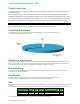
According to this method, the potential recyclability ratio is: 22%.
As described in the recyclability calculation method this ratio includes only metals and plastics which have proven industrial recycling processes.
Environmental impacts
Life cycle assessment has been performed on the following life cycle phases: Materials and Manufacturing (M), Distribution (D), Installation (I)
Use (U), and End of life (E).
Modeling hypothesis and method:
- the calculation was performed on the AP9870 Power cord
- product packaging: is included
- Installation components: no special components included.
- scenario for the Use phase: this product range is included in the category 1: Energy passing product
Assumed service life is 10 years corresponding to the lifespan of the system
Use scenario is: Dissipation is 1.187 W, loading rate is 30% and service uptime percentage is 100%.
The electrical power model used for calculation is the average European model.
- End of life impacts are based on a worst case transport distance to the recycling plant (1000km)
Presentation of the product environmental impacts
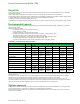
Environmental indicators Unit For AP9870 Power cord
S = M + D
+ I + U + E
M D I U E
Raw Material Depletion Y-1
3.02E-15 1.67E-15 3.53E-19
0
1.35E-15 7.05E-19
Energy Depletion MJ
1.22E+03 3.12E+01 2.59E-01
0
1.19E+03 5.17E-01
Water depletion
dm
3
1.84E+02 1.14E+01 2.46E-02
0
1.72E+02 4.91E-02
Global Warming
g
≈
CO
2
6.17E+04 1.52E+03 2.05E+01
0
6.01E+04 4.10E+01
Ozone Depletion g
≈
CFC-11
3.66E-03 3.49E-04 1.45E-05
0
3.26E-03 2.90E-05
Air Toxicity
m
3
1.07E+07 7.24E+05 3.86E+03
0
9.97E+06 7.72E+03
Photochemical Ozone Creation
g
≈
C
2
H
4
2.23E+01 1.88E+00 1.75E-02
0
2.03E+01 3.50E-02
Air acidification
g
≈
H
+
8.73E+00 6.08E-01 2.61E-03
0
8.11E+00 5.22E-03
Water Toxicity
dm
3
1.73E+04 1.95E+02 2.56E+00
0
1.71E+04 5.12E+00
Water Eutrophication
g
≈
PO
4
1.65E-01 2.30E-02 3.40E-04
0
1.41E-01 6.81E-04
Hazardous waste production kg
1.01E+00 1.26E-02 7.62E-06
0
9.97E-01 1.52E-05
Life cycle assessment has been performed with the EIME software (Environmental Impact and Management Explorer), version 4, and with its
database version 11.0.
The use phase is the life cycle phase which has the greatest impact on the majority of environmental indicators except for the raw material
depletion for which the manufacturing phase contribute significantly to the impacts due to the production of the copper.
According to this environmental analysis, proportionality rules may be used to evaluate the impacts of other products of this range: The
environmental impacts of the manufacturing, the distribution and the end of life phase are proportional to the mass of the product. The impacts
of the use phase will vary according to size of the cable and to the technical specifications of the complete system.
System approach
As the products of the range are designed in accordance with the RoHS Directive (European Directive 2002/95/EC of 27 January 2003), they
can be incorporated without any restriction in an assembly or an installation subject to this Directive.
Please note that the values given above are only valid within the context specified and cannot be used directly to draw up the environmental
assessment of an installation.