
Specifications






R
7
Ensure Proper Power-up with Foldback
Supplies
Foldback power supplies protect con-
nected equipment by reducing excess
current (and thus output voltage)
along a foldback path. When testing
foldback power supplies using an
electronic load, you need to take
steps to be sure the power supply
starts properly.
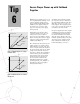
When using an electronic load in
constant resistance mode, the cur-
rent increases as the resistance
decreases, R
1
to R
2
, until the current
limit is reached; after that, the supply
reduces its output current along the
foldback path (Figure 1).
For constant current load, the power
supply operates in constant voltage
mode while the electronic load oper-
ates in constant current mode. When
the power supply starts up, its output
voltage is zero, and the electronic
load tries to satisfy the programmed
current value (I
1
) by decreasing the
load resistance. The power supply
interprets the low load value as
an over-current condition, and
immediately folds back to a stable
operating point (P
2
or P
3
in Figure 2,
depending on the power supply’s
startup characteristics).
To alleviate this problem, program
the electronic load to a value below
the current limit foldback point (I
min
).
This value can be close to zero on
many supplies. After applying power
to the source, increase the load’s cur-
rent limit to the desired value.
For power supplies that don’t require
a minimum load current at all times,
you can initially program the load
in constant resistance mode. Then,
when the power supply reaches its
nominal operating voltage, switch the
electronic load to constant current
mode. (During the transition, the
load momentarily goes to zero.)
Figure 1: Foldback behavior in constant
resistance mode
Figure 2: Foldback behavior for constant
current load
Tip
6
V
I
Resistive Load
Foldback
Region
R
1
R
2
(R
2
< R
1
)
V
I
Foldback
Region
Constant Current Load
I
min
I
1
P
3
P
2
P
1